

Argon the Science Dog is back to help you sniff out the best vacuum filtration setup for your lab. Whether you're working in a high school chemistry lab, a college organic chemistry course, or a more advanced professional research laboratory, choosing the right laboratory filtration system makes a huge difference in your results.
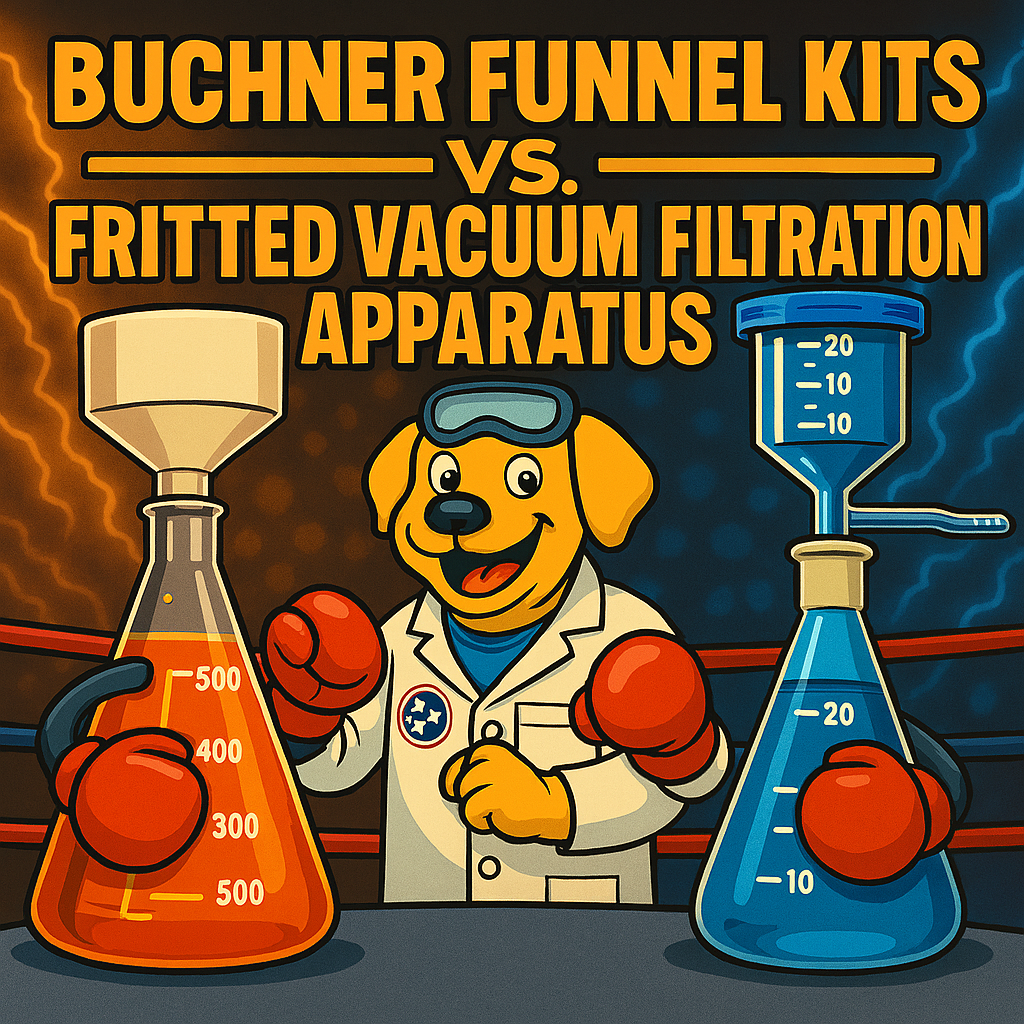
Today, we’re comparing two popular options:
Both are essential tools for vacuum filtration, solid‑liquid separation, and crystal collection, but they shine in different environments. Let’s dig in and remember, no matter which chemistry filtration kit you might need, my friends at TNLab.com have a great selection of both to choose from that will keep your solids and liquids separating and your tail wagging!
🧪 What Is a Buchner Funnel Flask Kit?
You’ll see these everywhere—from high school chemistry classrooms to undergraduate teaching labs. A standard Buchner Funnel Flask Kit includes:
- A vacuum filter flask
- A Buchner funnel (porcelain, ceramic, or plastic)
- A rubber stopper
- Qualitative Filter paper
When vacuum is applied, the filter paper traps solids, making Buchner funnels perfect for general-purpose filtration.
🐶 Why Buchner Funnels Are Great for School Labs
1. Versatile and beginner-friendly
Teachers love them because students can swap in different grades of filter paper based on the experiment. Great for learning precipitation, recrystallization, and solution clarification.
2. Affordable and durable
Budget-conscious high school and college labs rely on Buchner kits because they’re affordable and rugged enough for daily use.
3. Perfect for crystal collection
If you're doing recrystallization in an organic chemistry lab—sniff yeah!—the Buchner funnel is your best friend.
⚠️ Limitations of Buchner Filtration
- Filter paper can introduce variability
- Requires a tight seal to maintain vacuum
- Not ideal for fine particulate filtration
- Less suitable for high‑precision analytical work
🧫 What Is a Fritted Vacuum Filtration Apparatus?
Now we’re moving into more advanced scientific territory.
A Fritted Vacuum Filtration Apparatus Set includes:
- A sintered‑glass frit filter fused into the funnel
- A clamp and support base
- A thick‑wall vacuum flask
- A glass reservoir
The fritted glass disc has a precisely controlled porosity—an upgrade from filter paper.
🐾 Why Fritted Filtration Apparatus Sets Shine in Advanced Labs
1. Highly reproducible filtration results
Since the frit has a fixed pore size, filtration becomes consistent—perfect for college analytical chemistry courses and professional labs.
2. No filter paper needed
Less prep time + fewer variables = happier scientists (and dogs).
3. Excellent chemical resistance
These systems hold up against solvents and corrosive chemicals often used in upper‑level college and research labs.
4. Ideal for fine particulate and analytical filtration
Great for environmental testing, microbiology, suspended solids analysis, and high‑precision sample prep.
⚠️ Limitations of Fritted Filters
- Fragile—handle like glass bones
- Higher cost
- Frits can clog with heavy solids
- Require careful cleaning to maintain pore integrity
🧬 Which Filtration System Should You Choose?
🐶 Choose a Buchner Funnel Flask Kit if:
✔ You’re in a high school or early college chemistry lab
✔ You need a general-purpose vacuum filtration system
✔ You’re collecting crystals or large solids
✔ You want inexpensive, flexible filtration
✔ You frequently switch pore sizes via different filter papers
🧠 Choose a Fritted Vacuum Filtration Apparatus if:
✔ You’re in an upper‑level college organic or analytical lab
✔ You need precise, reproducible particulate retention
✔ You handle fine solids or regulated samples
✔ You prefer a paper‑free workflow
✔ You’re working with strong solvents or corrosive chemicals
🎓 Conclusion from Argon the Science Dog
Both systems earn a big tail wag from me, but they help different scientists—and different labs—reach their goals:
- Buchner Funnel Kits = best for education, flexibility, routine filtration, and crystal collection
- Fritted Vacuum Filtration Apparatus = best for high‑precision, analytical, and professional research filtration
Choose the right tool and you’ll fetch faster filtration, better crystal recovery, and more consistent results—no matter what level of science you're exploring.